January 23, 2024
Payment gateway
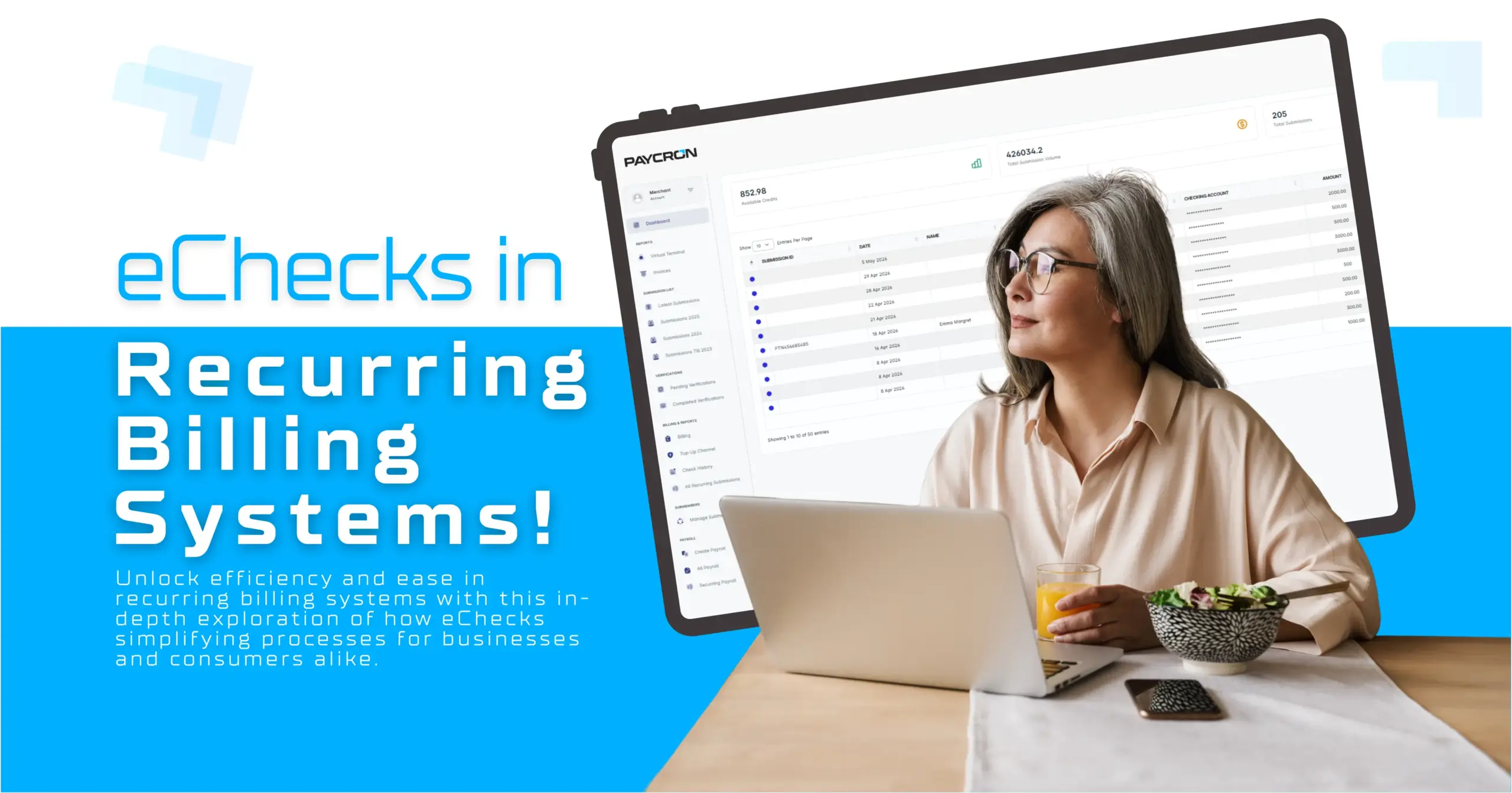
Streamlining Payments — The Power of eChecks in Recurring Billing Systems!
In the fast-paced world of modern commerce, recurring billing systems play a pivotal role. They facilitate seamless transactions for businesses and ensure ultimate convenience for consumers. However, as customer expectations shift and technology continues to evolve, the methods we use to handle recurring payments must step up.
If you are relying solely on credit cards to fuel your subscription model, membership site, or monthly service billing, you are likely leaving money on the table. One innovative solution that has solidified its place as a true game-changer is the eCheck.
Let’s delve into the intricacies of how eChecks simplify recurring billing systems, providing a highly reliable, compliant, and cost-efficient alternative for U.S. businesses and their customers.
Table of Contents —
Understanding the Landscape of Recurring Billing Systems —
Whether you run a SaaS platform, a digital subscription service, a gym, or a utility company, recurring billing involves the automatic withdrawal of funds from a customer’s account on a regular basis. It is a fantastic way for businesses to lock in predictable revenue without relying on manual intervention for every single transaction.
However, managing these pipelines at scale poses unique operational hurdles. You need highly secure payment methods, experiences that minimize customer friction, and systems that strictly comply with ever-tightening financial regulations. While credit cards have traditionally carried this weight, their systemic vulnerabilities, like expiration dates and high interchange fees, are forcing businesses to look toward the bank account itself.
What Exactly is an eCheck?
An eCheck or electronic check is simply a digital version of a traditional paper check. It carries the same routing and account information but is processed entirely electronically.
In the United States, eChecks are routed through the Automated Clearing House (ACH) Network, which is overseen by Nacha. Well, to put their scale into perspective, the ACH Network processed over 33.6 billion payments totaling more than $86.2 trillion in 2024 alone.
[Customer Authorizes Payment]
         │
         ▼
[Payment Processor captures Routing/Account numbers]
         │
         ▼
[Transaction routed via ACH Network (Nacha Rules)]
         │
         ▼
[Funds cleared directly from Customer Bank to Merchant Bank]
When you look under the hood, an eCheck cuts out the physical paper, the mailbox, and the manual trips to the bank, transforming bank-to-bank transfers into a smooth, automated digital experience.
The Mechanics of eChecks in Recurring Billing —
Actually, incorporating eChecks into your automated billing structure does more than just add a checkbox at checkout. It fundamentally optimizes your cash flow. Let’s look at the core mechanics of how they streamline operations.
1. Robust Security and Risk Mitigation:
Data breaches are an ongoing concern for U.S. consumers. Because eChecks route directly through the heavily encrypted banking infrastructure, they bypass the multi-layered vulnerabilities associated with card networks. Furthermore, under Nacha guidelines, strict account validation rules require businesses to verify a consumer’s bank account before initiating the first debit. This significantly reduces administrative errors and fraudulent setups.
2. Massive Cost-Efficiency for Businesses:
This is where business owners really see the difference. Processing traditional credit cards typically eats up 1.5% to 3.5% of every single transaction. If you are billing clients thousands of dollars a month, those fees hurt. eChecks, on the other hand, generally feature flat-rate pricing, often costing just pennies to a few dimes per transaction, regardless of the ticket size.
3. Seamless Integration with Modern Payment Gateways:
You do not need to tear down your existing financial software. Modern API-driven platforms or specialized merchant account providers make it incredibly simple to integrate eCheck capability into your current checkout flow alongside credit cards.
4. Consumer Flexibility and Peace of Mind:
From the consumer’s perspective, eChecks offer a highly trusted alternative. Many users prefer not to max out or share their credit card numbers online. By providing their account and routing numbers once, they can authorize an ongoing, automated payment schedule, ensuring their services never lapse due to a forgotten deadline.
Key Advantages of eChecks Over Credit Cards —
To truly understand why industry leaders like Visa and Mastercard are heavily investing in open banking and bank-to-bank technologies, look at the structural advantages eChecks hold over standard credit card rails.
| Feature | Credit Card Processing | eCheck (ACH) Processing |
| Pricing Structure | Percentage-based fee (1.5% – 3.5% + fixed fee) | Flat fee per transaction (typically $0.25 – $1.50) |
| Expiration Factor | High risk (Cards expire, get lost, or are stolen every 3 years) | Extremely low risk (Bank accounts rarely change) |
| Primary Failure Point | Credit limits reached, card frozen, expired credentials | Insufficient funds (NSF) |
| Ideal For | Small retail tickets, instant impulse buys | High-value invoices, B2B billing, monthly subscriptions |
Eliminating Involuntary Churn:
Involuntary churn is the silent killer of subscription models. It happens when a customer wants to keep paying you, but their credit card declines because it has expired, been lost, or has been replaced due to fraud.
According to major fintech studies, card-related declines account for up to 30% of subscription cancellations.
Bank accounts, however, don’t expire. An eCheck creates a “sticky” payment relationship that remains steady for years, preserving customer lifetime value.
Increased Predictability and Fast-Clearing Options:
For a long time, the biggest knock against eChecks was speed. Standard ACH used to take 3 to 5 business days to clear. But the landscape has completely shifted. Thanks to Nacha’s continuous upgrades to Same-Day ACH, eligible transactions can clear within a single business day. This injection of speed gives businesses vastly superior liquidity and predictable cash flow planning.
Real-World Challenges And How to Handle Them?
No payment method is perfect, and transitioning your users requires an intentional strategy. Here is what you should keep in mind:
- Customer Onboarding Education: Some users might wonder, “Is it safe to give my bank details?” You see, a proactive approach is best here. Reassure them by clearly highlighting that their information is fully encrypted and governed by the same rigorous federal regulations that protect their online banking.
- Managing Processing Timelines: Even with Same-Day ACH options, eChecks are not instantaneous, unlike a credit card authorization. To stay ahead of this, ensure your subscription terms clearly state when funds will be pulled and how long processing takes to prevent unexpected overdraft complaints.
- The Crucial Step of Bank Account Validation: To stay fully compliant with Nacha standards, you must use instant verification tools (such as Plaid or micro-deposits) to confirm that the bank account is active and belongs to the customer before you run the first automated charge.
The Future of Recurring Payments —
The U.S. financial landscape is racing toward real-time ecosystems. While newer instant infrastructures like the Federal Reserve’s FedNow Service and The Clearing House’s RTP Network continue to expand across retail and consumer applications, eChecks backed by the reliable ACH infrastructure remain the heavy-duty operational backbone for automated, recurring business revenue. By offering eChecks alongside card payments, you give your company a highly efficient, future-proof financial foundation.
People Also Ask —
1. Is an eCheck the exact same thing as an ACH transfer?
Essentially, yes. The term “eCheck” is a consumer-facing marketing phrase used to describe an electronic transaction that replicates a paper check, while “ACH” (Automated Clearing House) refers to the underlying federal banking network that securely moves the money.
2. Can a customer dispute or chargeback an eCheck payment?
Yes, customers can dispute an eCheck under federal Regulation E, but the rules are much stricter than credit cards. Consumers generally have up to 60 days to dispute an unauthorized charge, but they must prove to their bank that no authorization agreement existed.
3. How long does it typically take for an eCheck to clear?
Standard eCheck transactions settle in 2 to 3 business days. However, if your payment processor utilizes Nacha’s Same-Day ACH windows, transactions submitted early in the business day can clear and hit your account by that evening.
4. What happens if an eCheck bounces due to insufficient funds?
If a customer doesn’t have enough money in their account, the transaction will fail, and you will receive an ACH return code (typically an R01 for Insufficient Funds). Most automated billing systems can be configured to instantly notify the client or automatically retry the account a few days later.
5. Are eChecks safe for high-ticket recurring services?
Absolutely. eChecks are incredibly secure because they pass through bank-grade encrypted networks. In fact, because they don’t involve a physical card that can be dropped or skimmed, they are widely considered one of the safest ways to move large corporate invoices and recurring fees.
6. Do I need special software to accept eChecks on my website?
You don’t need anything entirely separate. Most leading payment gateways allow you to enable ACH/eCheck processing with a simple configuration switch or a minor update to your existing checkout API.
7. How does Nacha’s WEB Debit rule affect my business?
If you accept eChecks through an online portal or app, Nacha requires you to actively validate that the bank account is legitimate and open before submitting the transaction. Using an integrated verification tool satisfies this requirement completely.
8. Why should a subscription business offer eChecks if credit cards are faster?
Cost savings and customer retention. Credit cards charge percentage fees that eat into your margins, and they frequently decline due to expiration or replacement. eChecks charge small flat fees and rarely change, drastically lowering involuntary customer churn.
9. Can I use eChecks for international recurring billing?
eChecks are primarily native to the United States banking network. For international recurring billing, you would typically look to localized direct debit networks (like SEPA in Europe or BACS in the UK) rather than standard U.S. eChecks.
10. Can a business set up eChecks for B2B recurring transactions?
Yes, eChecks are exceptionally popular for Business-to-Business (B2B) setups. B2B transactions often involve significantly higher invoice totals, meaning the flat-fee structure of an eCheck saves companies thousands of dollars compared to card percentage fees.

More related blogs
- Electronic Check Payment
- Increase transaction success rates
What is Intelligent Payment Routing — How Large Merchants Increase Payment Approval Rates! 
- Electronic Check Payment
- Increase transaction success rates
- Merchant services company
- Can BOI compliance delay merchant account approval?
How the Corporate Transparency Act Affects Merchant Account Approvals?
- Merchant services company
- Can BOI compliance delay merchant account approval?
- Credit Card PCI Compliance
- vulnerability scanning
What Is PCI DSS 4.0 Level 1 Certification and Why Is It Important?
- Credit Card PCI Compliance
- vulnerability scanning


