June 25, 2026

High Risk Merchant Account
How Your Business Structure Shapes Payment Processor Approval in 2026?
When launching a new business venture in the United States, your to-do list is predictably massive. You are finalizing product lines, building a digital storefront, and trying to secure a commercial footprint. Somewhere in that flurry of activity, you check off a seemingly mundane administrative task: choosing a legal structure. You form an LLC, set up a Sole Proprietorship, or opt for a C-Corp. It feels like a purely tax-driven decision, right? Well, not exactly. What many merchants do not realize until they are staring at an unexpected rejection letter is that your business structure is actually the very first domino in your payment processing lifecycle. In the contemporary financial ecosystem, heavily influenced by strict risk models and updated underwriting mandates like Visa’s Acceptance Risk Standards (VARS), your chosen legal structure dictates exactly how a payment processor and traditional acquiring banks view your risk profile.
If you have ever wondered why some businesses get approved for a merchant account in three minutes flat while others languish in manual underwriting limbo for weeks, the answer often traces back to how your entity is legally built. Let’s pull back the curtain on how payment underwriters evaluate your business structure and what you can do to guarantee a seamless approval.
Table of Contents —
- 1. The Underwriter’s Lens — KYB, AML, and Risk Distribution
- 2. Structure Breakdown — Processing Approvals from Simplest to Most Complex
- 3. High-Risk Verticals and the Entity Structure Multiplier —
- 4. How to Prep Your Business Structure for Instant Approval?
- 5. Summary Matrix — Processing Suitability by Structure
- Final Thoughts —
- Frequently Asked Questions (FAQ) —
- 1. Can I change my business structure with my payment processor after I am approved?
- 2. Why does a payment processor need my personal SSN if I am applying as an LLC?
- 3. Does my personal credit score matter if I apply under a corporate business structure?
- 4. What happens if my payment processor flags my business structure as "opaque"?
1. The Underwriter’s Lens — KYB, AML, and Risk Distribution
Before we look at specific structures, we need to understand what happens behind the scenes when you submit a merchant application.
Payment processors are not just software utilities; they are financial gatekeepers. Under federal regulations, including strict Anti-Money Laundering (AML) frameworks and Know Your Customer/Know Your Business (KYB) mandates, processors are legally obligated to verify exactly who they are doing business with.
Underwriters look at your business structure to answer three fundamental questions:
- Identity Verification: Can we verify that this legal entity actually exists with the state and IRS?
- Ultimate Beneficial Ownership (UBO): Who are the physical human beings that own or control more than 25% of this company?
- Financial Liability: If this business falls victim to a massive wave of chargebacks or goes insolvent, who is legally on the hook for the lost funds?
Because payment facilitators (PayFacs) and acquiring banks absorb the ultimate financial liability if a merchant defaults on fraud or refund costs, they use your business structure to calculate their downstream risk management exposure.
2. Structure Breakdown — Processing Approvals from Simplest to Most Complex
Different legal entities present entirely unique operational risk practices to underwriting teams. Let’s break down how the most common U.S. business structures perform during the onboarding stage.
Sole Proprietorships – The Fast but Fragile Track
A Sole Proprietorship is the simplest way to run a business in the U.S. There is no separation between the business owner and the business entity.
- The Onboarding Experience: For micro-merchants using aggregators like Square, PayPal or Paycron, onboarding a Sole Proprietorship is incredibly fast. You typically provide your Social Security Number (SSN) instead of an Employer Identification Number (EIN), and automated underwriting models approve you almost instantly.
- The Hidden Risk: Because there is no legal distinction between personal and business assets, you assume 100% personal liability. If your business experiences a sudden spike in chargebacks, the processor can directly pursue your personal bank accounts to recover losses. Furthermore, Sole Proprietorships face much tighter transaction volume ceilings. If your revenue suddenly surges past a few thousand dollars a month, traditional processors will freeze your funds and mandate that you transition to a formal corporate structure.
Limited Liability Companies (LLCs) – The Sweet Spot for Modern Fintech
For the vast majority of e-commerce brands, software-as-a-service (SaaS) platforms, and mid-sized retail operations, the LLC is the gold standard for payment processing approval.
- The Onboarding Experience: Processors love LLCs because they balance clear documentation with clear accountability. When you apply with an LLC, you provide an explicit EIN from the IRS and Articles of Organization from your state. This clean paper trail allows automated engines to instantly cross-reference state registries.
- The Structural Advantage: An LLC creates a distinct legal “person.” It allows the payment processor to evaluate the financial health of the business entity while still identifying a clear Ultimate Beneficial Owner (UBO) for compliance screening. If you are a single-member LLC, approval is highly streamlined. For multi-member LLCs, you simply need to disclose the key partners holding significant equity.
Partnerships (General and Limited) – The Multi-Owner Speedbump
Whether you have a General Partnership (GP) or a Limited Partnership (LP), having multiple partners instantly adds friction to the processing application.
- The Onboarding Experience: Modern compliance mandates expect real-time identity verification for anyone holding significant equity. If your partnership agreement splits ownership across several entities or individuals, the underwriter cannot simply approve the application based on one person’s credit profile.
- The Underwriting Bottleneck: Underwriters must run background and sanctions checks on all general partners who meet the ownership threshold. If one partner has a spotty personal credit history, a past bankruptcy, or a flagged profile on a payment-industry watchlist, it can stall or completely tank the entire application, regardless of how healthy the business itself is.
Corporations (C-Corps and S-Corps) – Institutional Trust with Heavy Documentation
Corporations represent the highest level of institutional legitimacy, but they also require the most thorough, manual paper trail.
Corporate Underwriting Path
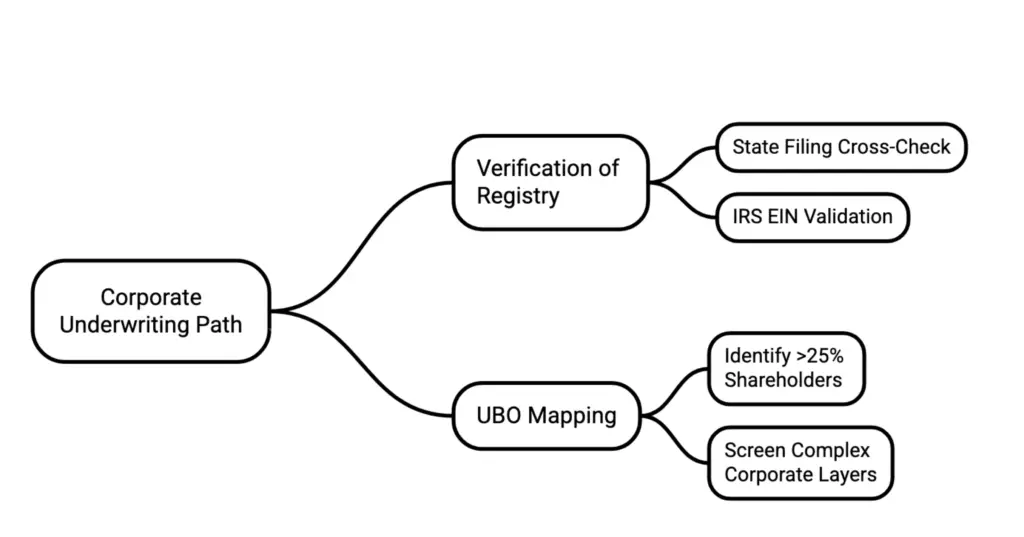
- The Onboarding Experience: Large-scale processors like Adyen, Stripe, Paycron, and Checkout.com are built to handle enterprise-grade corporations. Because corporations feature rigid governance structures (Bylaws, Boards of Directors, and clear share allocations), they are viewed as highly stable, low-risk entities regarding institutional fraud.
- The Verification Challenge: The complication with corporations usually stems from complex ownership webs. If your C-Corp is owned by a holding company, which is in turn owned by a venture capital fund, human underwriters must manually map out the entity chain to locate the physical individuals who hold ultimate control. For early-stage startups, this means your processing approval might take several days to a week while compliance officers verify your cap table.
3. High-Risk Verticals and the Entity Structure Multiplier —
Actually, it is vital to note that your business structure does not exist in a vacuum. It interacts directly with your industry type.
If you operate in what the payment world considers a “high-risk vertical”, such as credit repair, travel booking, subscription boxes, digital gaming, or nutraceuticals, your business structure becomes a make-or-break factor.
A high-risk business operating as a simple Sole Proprietorship is almost universally rejected by mainstream processors. Why? Because the structural risk of an un-incorporated individual combining with the high chargeback volatility of a risky industry creates an unacceptably high probability of financial loss for the processor. Conversely, if that same high-risk concept is backed by a well-capitalized LLC or C-Corp with clear operational governance, specialized high-risk processors (like NMI or specialized acquiring banks) are far more likely to grant an approval, provided an upfront rolling reserve is established.
4. How to Prep Your Business Structure for Instant Approval?
To ensure your onboarding process goes off without a hitch, use this expert checklist before submitting your merchant application:
- Perfect Matching Details: Ensure the business name and address on your state incorporation documents match your IRS EIN letter, your business bank account statement, and the digital footprint on your website down to the exact punctuation. Even a slight variation (like “Co.” vs “Company”) can trigger an automated fraud flag.
- Keep Your Business Bank Account Separate: Never apply for a corporate or LLC merchant account using a personal checking account. The names on the account must align perfectly to satisfy bank-account validation checks.
- Have Government IDs Ready for All Major Owners: Be prepared to provide the names, dates of birth, and Social Security Numbers of any individual owning more than 25% of the entity to satisfy corporate UBO screening.
- Maintain an Active, Compliant Website: Underwriters will check your website to see if your business model matches your legal structure. Ensure your Terms of Service, Privacy Policy, and Refund Policy explicitly display your legal entity name.
5. Summary Matrix — Processing Suitability by Structure
| Business Structure | Onboarding Speed | Volume Ceiling | Risk Documentation Needed | Ideal For |
| Sole Proprietorship | Ultra-Fast (Minutes) | Low | Minimal (SSN) | Part-time freelancers, micro-merchants |
| LLC | Fast (Hours) | High / Scalable | Standard (EIN, Articles of Organization) | E-commerce, SaaS, scaling small businesses |
| Partnership | Moderate (Days) | High | High (Partnership Agreement, Multi-ID check) | Professional services, joint ventures |
| Corporation | Slow to Moderate | Unlimited | Very High (Bylaws, Shareholder Registries) | Venture-backed startups, enterprise firms |
Final Thoughts —
At the end of the day, payment processing is the lifeblood of your cash flow. While it is tempting to pick a business structure solely based on what your accountant recommends for your annual tax return, you must consider how that structure looks to a financial underwriter.
By formalizing your entity, maintaining clean documentation, and understanding how your structural design impacts your risk profile, you can transform payment processing from a stressful hurdle into a seamless competitive advantage.
Frequently Asked Questions (FAQ) —
1. Can I change my business structure with my payment processor after I am approved?
Yes, but it is not as simple as updating a settings tab. If you transition from a Sole Proprietorship to an LLC or Corporation, you are legally creating a brand-new entity. Your processor will require you to submit a new application, complete fresh KYB checks, and sign a new merchant agreement under your updated EIN.
2. Why does a payment processor need my personal SSN if I am applying as an LLC?
Even if your LLC shields you from standard commercial liability, federal Know Your Customer laws require processors to verify the real human identities behind the business entity. This prevents bad actors from using anonymous shell companies to move illicit funds or bypass financial sanctions.
3. Does my personal credit score matter if I apply under a corporate business structure?
Yes, particularly for small-to-mid-sized businesses. For LLCs and corporations without extensive financial histories, underwriters frequently look at the personal credit score of the primary guarantor or majority owner to gauge overall financial responsibility and assess the likelihood of operational stability.
4. What happens if my payment processor flags my business structure as “opaque”?
An “opaque” structure usually means the underwriter cannot easily trace who owns the company due to nested holding companies or complex trust structures. If flagged, the processor will pause your account and require legal documentation, such as an operating agreement or a certified cap table, to explicitly verify your ultimate beneficial owners.

More related blogs
- High Risk Processing
- how can a service business collect payments by phone
The Ultimate Expert Guide to Text to Pay and Payment Links for Service Businesses. 
- High Risk Processing
- how can a service business collect payments by phone

- Echeck Payment Processor
- deferred delivery
How Payment Risk Is Actually Assessed by Processors — Beyond Credit Scores!
- Echeck Payment Processor
- deferred delivery

- Merchant services company
- payment authentication
What is Visa’s Digital Commerce Authentication Program (DCAP) — Everything you need to know!
- Merchant services company
- payment authentication


