March 27, 2026
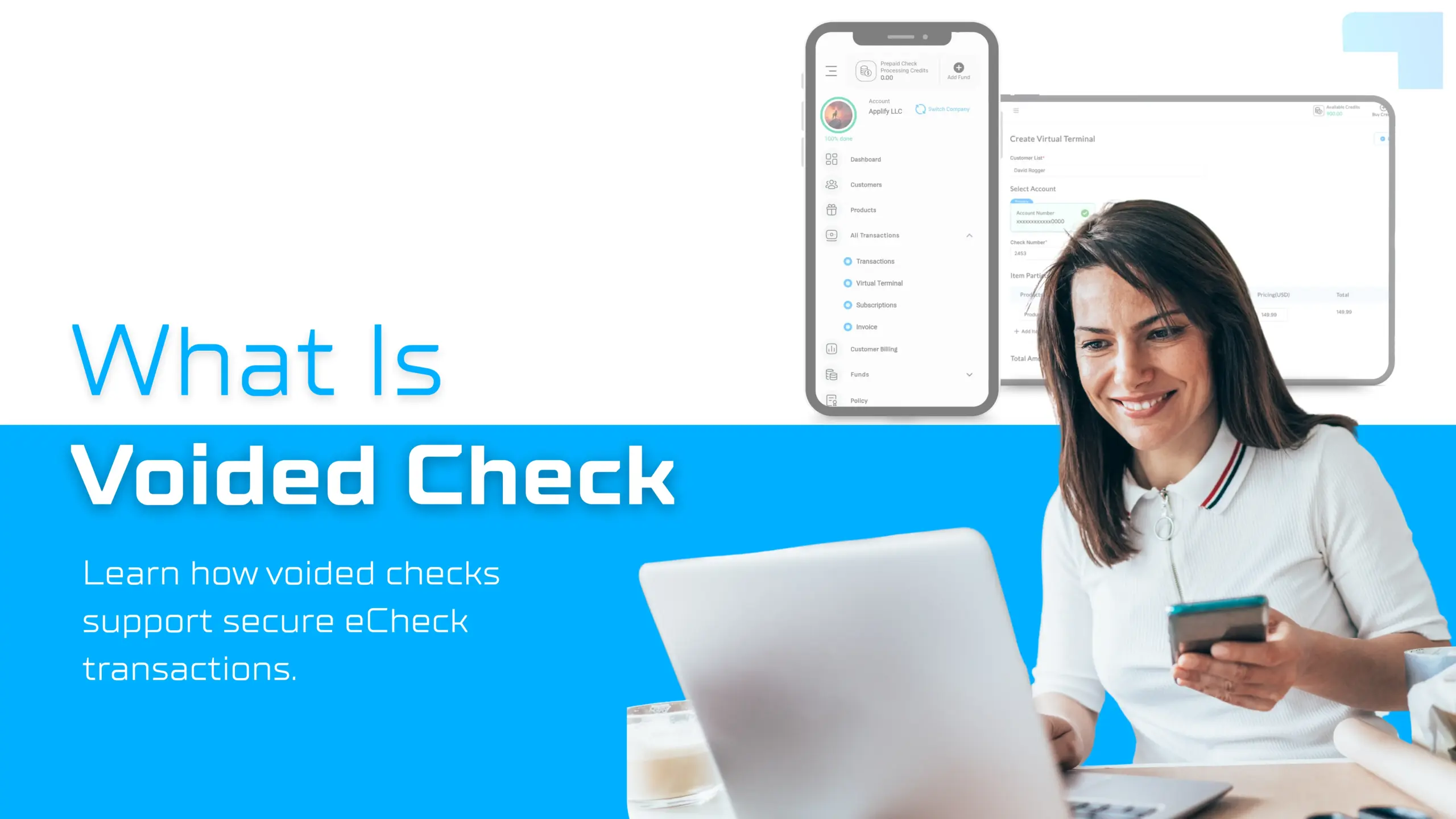
Echeck Payment Processor
What Is a Voided Check and Why Do Businesses Need It?
If you’ve ever started a new job or set up an automatic bill payment, chances are someone asked you for a voided check. And if you’re a business owner processing payroll or accepting eCheck payments, you’ve probably asked for one yourself. Yet, surprisingly, a lot of people, even seasoned business professionals, aren’t entirely sure what makes a voided check different from any other check, or why it carries so much weight in the U.S. payment ecosystem.
Well, let’s fix that. In this guide, we’ll break down exactly what a voided check is, how businesses use it, how it fits into the broader world of electronic payments, and, critically, what the shift toward digital banking means for this old-school financial tool.
Table of Contents —
- What Is a Voided Check?
- Why Do Businesses Ask for a Voided Check?
- Voided Check vs. Canceled Check: What's the Difference?
- How to Void a Check Correctly —
- What If You Don't Have Paper Checks?
- Voided Checks in the Age of Digital Payments —
- Security Best Practices for Handling Voided Checks —
- People Also Ask —
What Is a Voided Check?
Simply put, a voided check is a regular paper check with the word “VOID” written in large, clear capital letters across the front using permanent ink (blue or black pen). That single word renders the check completely unusable for making a payment; it cannot be cashed, deposited, or filled out for any transaction.
Here’s the key thing, though: even though the check can’t be used for payment, it still displays all the critical banking information printed at the bottom:
- Routing Number — identifies your bank or financial institution
- Account Number — identifies your specific bank account
- Check Number — helps with internal record-keeping
That bottom row of numbers, printed in magnetic ink and called the MICR line (Magnetic Ink Character Recognition), is really what makes a voided check so valuable. It gives the recipient everything they need to initiate electronic transactions, without any risk of the check being misused.
Why Do Businesses Ask for a Voided Check?
You see, businesses don’t ask for a voided check because they want a piece of paper. They want the banking data on it, verified, accurate, and directly from the source. Here are the most common reasons:
1. Setting Up Direct Deposit for Payroll:
This is by far the most frequent use case. When an employee joins a company, HR or payroll needs their routing and account numbers to send wages directly to their bank account via the ACH (Automated Clearing House) network.
The numbers matter enormously here. According to a 2025 survey by PayrollOrg, nearly 93% of U.S. employees are paid via direct deposit, and the Social Security Administration reports that over 99% of Americans receive their monthly Social Security benefits through direct deposit. That’s an enormous volume of ACH transactions, all of which depend on accurate banking information at setup.
A voided check provides accuracy with minimal risk of a typo or data-entry error. Many modern payroll systems, used by platforms, can even digitally scan the MICR line from a voided check, further eliminating human error.
2. Establishing ACH Debit Authorizations:
Businesses that collect recurring payments, such as subscription services, insurance providers, utilities, SaaS companies, or property management firms, need verified bank details to initiate ACH debits from a customer’s account. A voided check provides reliable proof of those details.
Under NACHA Operating Rules (the governing body for the ACH network in the U.S.), businesses must obtain proper authorization before debiting any customer’s account. Collecting a voided check as part of the authorization process is a common, recognized practice for meeting that compliance requirement.
3. Enabling eCheck Payments:
Here’s where it gets especially relevant for fintech-forward businesses. An eCheck, also called an electronic check or ACH payment, is a digital version of a paper check. The customer authorizes a payment using their bank account details, and the transaction moves through the ACH network.
The ACH network processed 33.6 billion transactions valued at $86.2 trillion in 2024 alone (NACHA). Same-Day ACH, introduced to speed up processing times, saw over 1.2 billion transactions worth $3.2 trillion in 2024. eChecks typically cost businesses just 0.5%–1% per transaction, compared to 2.9%–4.2% for credit cards, making them a highly cost-effective payment method, especially for large transactions or high-volume recurring payments.
A voided check is often the starting point for linking a customer’s bank account to an eCheck payment system.
4. Vendor and B2B Payments:
For businesses paying suppliers, contractors, or service providers via ACH transfer, collecting a voided check (or equivalent banking verification) ensures funds arrive at the right account. This is especially important for high-value B2B transactions, where misrouted payments can be both costly and complicated to reverse.
5. Loan Repayments and Financial Account Linking:
Banks, lenders, and fintech lenders may request a voided check when setting up automatic loan repayments or linking an external checking account to an investment or savings platform.
Voided Check vs. Canceled Check: What’s the Difference?
This is a question that trips people up all the time, so let’s clear it up quickly.
| Terms | Voided Check | Canceled Check |
| What it is | A blank check marked “VOID” before use | A check that has been fully processed and paid |
| Used for | Sharing banking info for electronic setup | Proof that a payment was completed |
| Can it be cashed? | No | No (already cleared) |
| Who creates it? | The account holder | The bank, after processing |
A voided check is intentionally rendered unusable before it ever reaches a payee. A canceled check, on the other hand, has already gone through the full payment process; it was written, submitted, cleared by the bank, and the funds were transferred. Banks mark it “canceled” to show it has been paid.
In practice, you’d use a voided check to set up a new payroll direct deposit. You’d reference a canceled check as proof that a vendor payment cleared six months ago.
How to Void a Check Correctly —
It’s actually quite straightforward, but doing it properly matters:
- Start with a blank check, don’t fill in any fields (payee, date, amount, or signature)
- Use a blue or black permanent ink pen; pencils and colored inks won’t scan or photograph well.
- Write “VOID” in large capital letters across the front of the check, covering most of the face, but be careful not to obscure the routing and account numbers at the bottom
- Record the check number in your checkbook register, noting the date and purpose (e.g., “Voided for payroll setup, March 2025”)
- Handle it securely, even a voided check contains sensitive banking data; transmit it through secure portals, not plain email attachments
If you need to submit it digitally, take a clear, well-lit photo showing all the banking information. Many employers and payment platforms now accept digital copies through secure onboarding portals.
What If You Don’t Have Paper Checks?
This is increasingly common, especially among younger workers and digital-first businesses. The good news? There are solid alternatives.
As NACHA itself notes, “Gone are the days of submitting a voided check to HR”, at least for companies that have modernized their onboarding. Alternatives include:
- Bank-issued direct deposit authorization forms — printable from your online banking portal.
- Official bank letter — lists your routing and account numbers on bank letterhead.
- Pre-printed deposit slip — contains the same MICR line data.
- Secure payroll portal — employees enter routing and account numbers directly (with bank verification).
- Micro-deposit verification — the business deposits two small test amounts (e.g., $0.12 and $0.31) to verify account ownership.
Platforms offer instant bank verification tools that eliminate the need for a physical voided check entirely, using Plaid-style integrations to verify account details in real time.
Voided Checks in the Age of Digital Payments —
Let’s be real: paper checks are declining. The federal government itself has been actively moving away from them. An executive order directed a full transition to electronic payments for all federal disbursements by September 30, 2025, a move NACHA publicly supported, citing cost savings and fraud reduction. In 2024, the Treasury Department originated over 1.86 billion ACH payments, moving more than $8.5 trillion through the ACH Network.
That said, voided checks haven’t disappeared, especially in B2B settings, SMB payroll, and ACH onboarding workflows. They remain a trusted, low-tech way to verify banking data, and many businesses and financial institutions still rely on them because they’re reliable, universally understood, and easy to process.
For businesses, the practical takeaway is this: whether you’re collecting voided checks or using modern bank account verification tools, the underlying goal is the same: accurate, secure banking data to power safe electronic payments.
Security Best Practices for Handling Voided Checks —
Because a voided check still contains sensitive account information, businesses have real responsibilities around how they collect, store, and dispose of them:
- Collect securely — use encrypted portals or secure HR systems, not open email.
- Store with access controls — limit who can view employee or customer banking records.
- Don’t retain longer than necessary — NACHA requires businesses to keep ACH authorization records for at least two years after the last payment; don’t hold banking documents longer than needed.
- Dispose properly — shred physical copies using a cross-cut shredder; securely delete digital files
- Beware of check washing — a fraud technique where thieves use chemicals to erase ink and rewrite checks; this is why you should use permanent ink and never leave voided checks unsecured.
People Also Ask —
Q: Can a voided check be used for payment?
No. Once a check is marked “VOID” in permanent ink, it cannot be cashed, deposited, or used for any transaction. Its sole purpose is to provide banking information.
Q: Is a voided check the same as a starter check?
Not exactly. A starter check is a temporary check issued by a bank before personalized checks arrive. Some institutions don’t accept them for direct deposit setup because they may lack a printed name. Always confirm with the requesting party.
Q: What happens if I lose a voided check?
Contact your bank immediately. While it can’t be used for payment, it does contain your account and routing numbers, which could be exploited for fraudulent ACH transactions. Your bank can advise on whether to change your account number.
Q: Do businesses need to keep voided checks on file?
Businesses should retain ACH authorization documentation, which may include voided checks, for at least two years after the last transaction, per NACHA compliance requirements.
Q: What’s an alternative to a voided check for eCheck setup?
Bank-issued authorization forms, official bank letters, deposit slips, micro-deposit verification, and real-time bank verification tools (via Plaid or similar) are all widely accepted alternatives.
Q: How does a voided check relate to eCheck processing?
A voided check provides the routing and account numbers required to initiate ACH-based eCheck transactions. It’s often the first step in linking a customer’s bank account to an eCheck payment system.
Q: Can I submit a voided check electronically?
Yes. Many platforms accept digital photos or scanned copies submitted through secure onboarding portals. Avoid sending voided checks via unencrypted email.

More related blogs
- S-Corporation (S-Corp) Formation
- best business structure for payment gateway approval
How Your Business Structure Shapes Payment Processor Approval in 2026? 
- S-Corporation (S-Corp) Formation
- best business structure for payment gateway approval
- ecommerce merchant accounts
- Paycron
The Ultimate Expert Guide to Text to Pay and Payment Links for Service Businesses.
- ecommerce merchant accounts
- Paycron

- Credit Card Flat Rate Pricing
- merchant aggregation
How Payment Risk Is Actually Assessed by Processors — Beyond Credit Scores!
- Credit Card Flat Rate Pricing
- merchant aggregation


