August 5, 2025
Financial Services
Early Warning Score in Banking & Fintech!
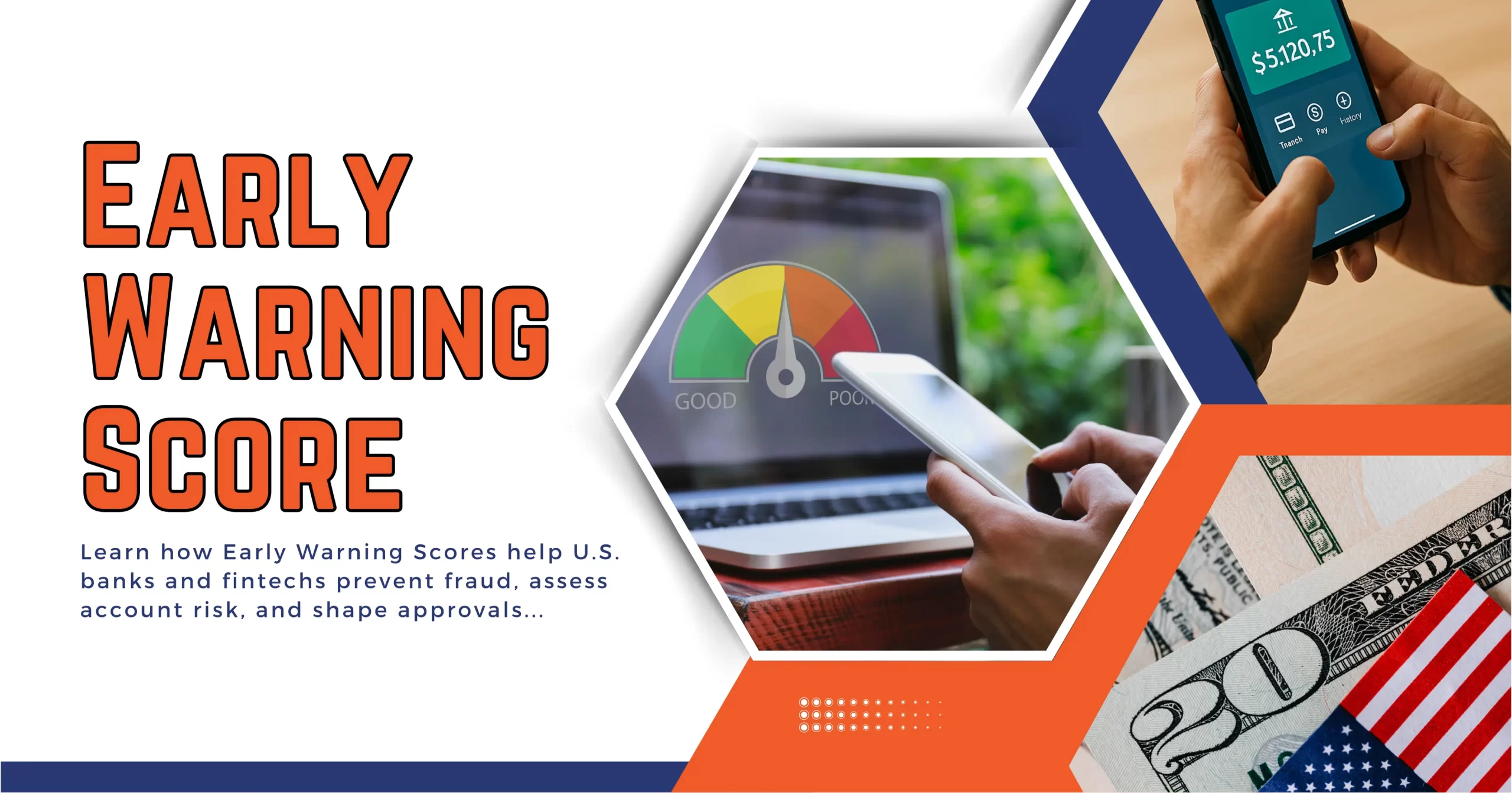
Fraud and financial risk are moving faster than ever. Whether it’s account takeovers, synthetic identities, or suspicious ACH transfers, banks and fintech companies need to act before the damage is done. The Early Warning Score has become a key tool for doing exactly that—helping financial institutions decide if an account application, payment, or transaction looks safe or risky in just seconds.
What Is an Early Warning Score in Banking?
In the U.S. banking and fintech world, an Early Warning Score is a numeric risk rating assigned to a customer or account. It’s designed to measure the likelihood of fraud, misuse, or default before a bank or payment processor approves an action.
This score isn’t about your creditworthiness—it’s about risk to the institution based on your banking history, account activity, and identity verification results.
How Early Warning Scores Are Generated —
Banks and fintechs don’t pull these numbers out of thin air. Scores come from multiple data streams, including:
- Early Warning Services (EWS) reports on account closures, bounced checks, ACH returns, or fraud flags.
- ChexSystems records of overdrafts, unpaid fees, and account misuse.
- Internal account history such as transaction volumes, NSF events, and chargebacks.
- Behavioral analytics like login patterns, device fingerprints, and biometric indicators.
All of these feed into fraud-detection models often powered by AI, that produce a risk score in real time or near real time.
Early Warning Score vs. Early Warning Services —
It’s easy to mix these up. The Early Warning Score is a metric or number assigned to indicate risk. Early Warning Services, on the other hand, is a bank-owned data-sharing network that supplies much of the account and identity information used to create that score.
Use Cases in the U.S. Financial Sector —
- Account opening decisions:
Before approving a checking account, savings account, or business account, banks check the risk score. High-risk scores may trigger denials or manual review.
- Merchant account underwriting:
Payment processors use the score to assess a business owner’s linked bank account history for signs of fraud or excessive returns.
- ACH & eCheck payment risk assessment:
Processors score accounts before accepting ACH or eCheck transactions to prevent failed payments or fraud.
- P2P payment verification:
Apps like Zelle, Venmo, and PayPal may use the score when linking bank accounts, blocking connections that appear risky.
Impact on Businesses & Consumers —
A high Early Warning Score can have immediate consequences:
- Denials for account openings or payment services.
- Holds on transactions pending review.
- Extra scrutiny during onboarding or while processing payments.
For consumers and businesses alike, this can mean delays, added paperwork, or even losing access to certain services.
Integration With Other Risk Tools —
The Early Warning Score is one part of a larger risk-management picture. Banks often combine it with:
- FICO scores to assess credit risk.
- ChexSystems data for account history.
- Internal fraud databases for institution-specific red flags.
This layered approach reduces blind spots and improves decision accuracy.
Compliance & Regulatory Considerations —
Since Early Warning Scores often rely on data from regulated consumer reporting agencies, they fall under:
- Fair Credit Reporting Act (FCRA) — consumers have the right to see their report once a year and dispute errors.
- Data privacy laws such as the California Consumer Privacy Act (CCPA) and state-level protections.
Financial institutions must ensure proper consent, secure storage, and responsible use of personal data.
Challenges & Limitations —
Even the best systems aren’t perfect:
- False positives can block legitimate customers.
- Data errors may unfairly lower scores.
- Disputes can take weeks to resolve.
- Bias risks in AI-driven models may unintentionally affect certain groups.
Balancing security and fairness remains a constant challenge.
Future Trends in Risk Scoring —
- AI-driven fraud prevention:
Leading institutions now use machine-learning systems capable of analyzing billions of data points in milliseconds, cutting fraud losses while reducing false positives.
- Behavioral biometrics:
Typing speed, swipe patterns, and device usage help verify users without extra friction.
- Open banking data sharing:
Consent-based data exchange between institutions is enabling richer, faster risk analysis.
As these technologies evolve, Early Warning Scores will become even more accurate and adaptive.
Final Thoughts —
For consumers:
- Keep your banking record clean—avoid overdrafts, chargebacks, and suspicious activity.
- Request your Early Warning Services report annually and dispute inaccuracies.
For businesses:
- Maintain strong fraud-prevention processes.
- Use verified accounts for all transactions.
- Work with payment providers who understand risk scoring and compliance.
In today’s financial landscape, the Early Warning Score is more than a number—it’s a gatekeeper. Staying proactive is the best way to keep the doors open.
FAQs — Quick Answers to Common EWS Queries:
Q: Does an Early Warning Score affect my credit score?
No. It’s separate from credit scores and won’t appear on your credit report.
Q: How can I see my data?
Request a free annual consumer report from Early Warning Services.
Q: What’s the difference between the Score and Early Warning Services?
The Score is the risk rating; Services is the data network that feeds it.
Q: How long do negative entries last?
Typically 5–7 years, depending on the severity.
Q: Can I dispute a bad score?
Yes, File a dispute with the reporting agency to correct errors.

More related blogs

- B2B Payment Processing
- FinCEN BOI
How the Corporate Transparency Act Affects Merchant Account Approvals? 
- B2B Payment Processing
- FinCEN BOI

- Merchant Account
- pci level 1
What Is PCI DSS 4.0 Level 1 Certification and Why Is It Important?
- Merchant Account
- pci level 1
- Payment Gateway Providers
- what is a high-risk merchant account structure
How Your Business Structure Shapes Payment Processor Approval in 2026?
- Payment Gateway Providers
- what is a high-risk merchant account structure


